
New Zealand Copied Our Phonics Check: 26%, Then 35%
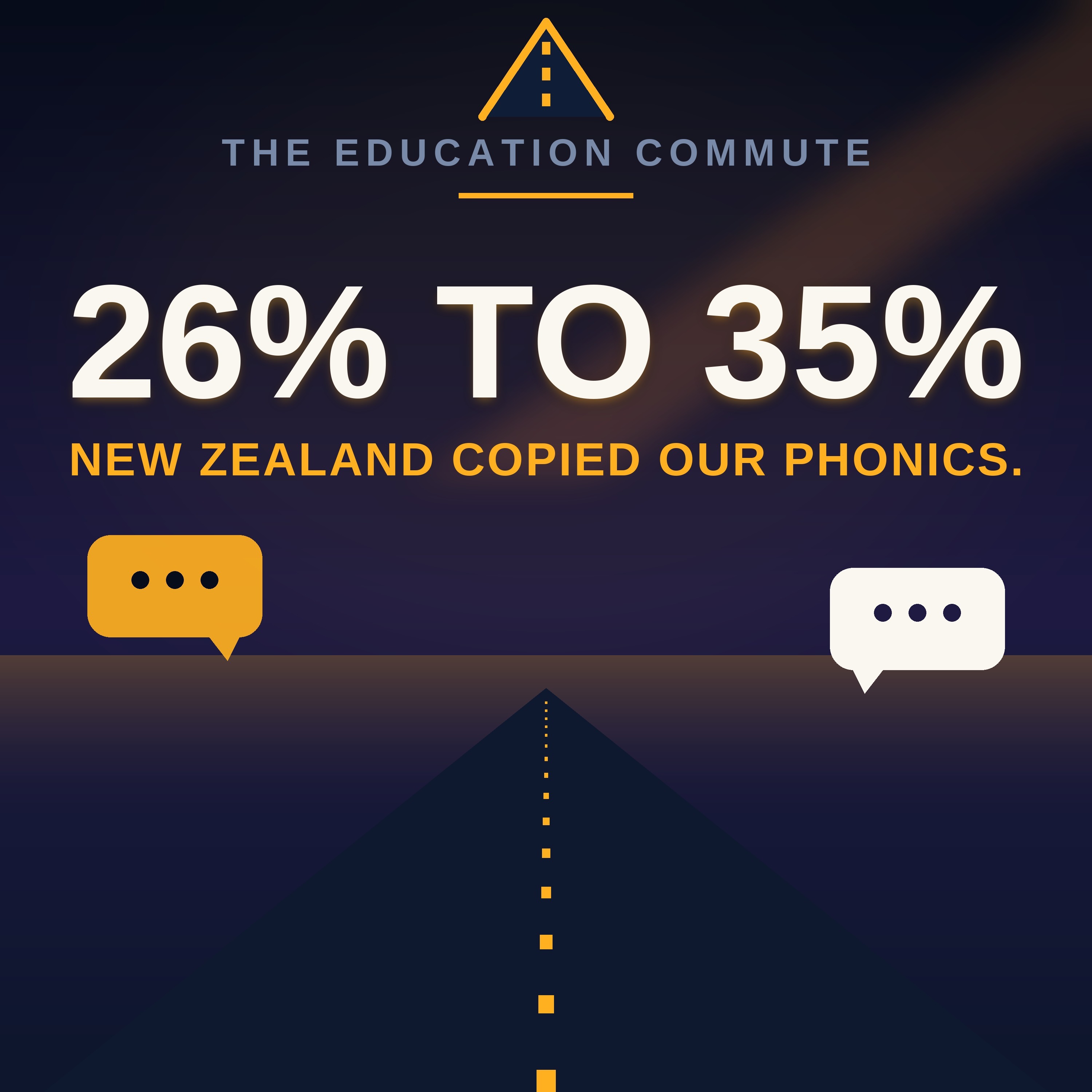
Forty words, real and made-up, read one child at a time — any Year 1 teacher in England knows the check. From 2025 New Zealand runs it twice in a child's first year, on top of a national structured-literacy mandate and an hour a day of reading. The first results: 26% at expectation after forty weeks in term one, 35% by term three. A Year 1 teacher and a document-reader work out what a country that just adopted England's model can actually tell England — and why the one number you can't compare is the headline one.
Printable one-pager for this episode, free: https://theeducationcommute.co.uk/#newsletter-staff
Two free newsletters, one for staff and one for parents and carers, same evidence written for the person reading it.
Sources: NZ Government — Transforming how our children learn to read (2 May 2024) https://www.beehive.govt.nz/release/transforming-how-our-children-learn-read · NZ Ministry of Education — Phonics checks and Terms 1 to 3, 2025 results https://newzealandcurriculum.tahurangi.education.govt.nz/phonics-checks-t32025-results · NZ Ministry of Education — One hour a day https://tahurangi.education.govt.nz/one-hour-a-day · DfE — Phonics screening check attainment 2024/25 https://explore-education-statistics.service.gov.uk/find-statistics/phonics-screening-check-attainment/2024-25
Both voices on this show are synthesised; the research, reading and editorial judgement are done by a serving practitioner.
Strand: Global Pioneers
Free printable one-pagers for this episode, one for staff and one for parents and carers.
Get the free newsletters · Listen on RSS.com · Watch on YouTube
Full transcript
Read the transcript
This is the education to mute. Both voices on this show are synthesized. The judgment isn't. 26%. Right. And then 35%. I mean, imagine testing a child's reading ability and seeing exactly those figures. The exact same check, right? Two terms apart. The exact same check, two terms apart. That is the share of New Zealand children reading at or above expectation after 40 weeks of school. Wow. Right. 26 % is the figure for the first term the check ran. And 35 percent is the figure for the third term.
Yes. And, you know, these figures were published by New Zealand's Ministry of Education in 2025. And the reason this particular set of figures is ours to discuss today is because of what that check actually is. Right. The format. Exactly. The check involves exactly 40 words. It includes real words and it includes made up words. Yeah. And those 40 words are read aloud to a teacher. Which, I mean, if you are listening to this and you are a year one teacher in England, you will recognize that format immediately.
We use made up words, sometimes called pseudo words, because a child cannot simply memorize them. Right. They have to work for it. Exactly. They have to actually decode the letters and sound them out. So that 40 word structure is highly specific. They copied it. I mean, they did. And this is the global commute strand of the education commute. I am Alex. Hi, Alex. I have been analyzing New Zealand's Ministry of Education releases and the ministry's results pages to show that the honest story here is much deeper and more interesting than just stating, you know, they copied us.
And I am Priya. I am speaking from the perspective of an English year one teacher. I have run the phonics screening check in June every year for, well. Longer than I would like to say. Fair enough. And if we're looking at another country adopting our model, we need to understand the reality of what that means. We should start with exactly what New Zealand did. Right. So in May of 2024, the New Zealand government made a very specific announcement. They announced that all state schools would teach reading through structured literacy starting from term one, 2025.
Well, let us clarify what structured literacy actually means in this context, just so you know exactly what is being mandated. Yeah, good idea. It is a highly explicit, systematic approach to teaching reading. It relies on teaching children the direct relationship between letters and sounds rather than leaving the acquisition of reading to chance. Precisely. And they put specific funding behind that rollout to make sure it actually happened. There were 67 million New Zealand dollars in the budget behind this announcement. 67 million New Zealand dollars. Yes. Where exactly did that money go?
Because if you mandate a new teaching method across all state schools, I mean, you have to pay for the materials and the training. Oh, absolutely. That 67 million New Zealand dollars was dedicated to three distinct things. OK. First. It was dedicated to professional development for the teachers. Vital. Second, it was dedicated to decodable books for the classrooms. Right. And third, it was dedicated to the phonics checks themselves. Okay. So they also used figures to justify that financial investment. You do not spend 67 million New Zealand dollars without a clear reason.
No, you do not. The statistics that drove this entire reform actually came from year eight. Year eight. Yes. The data showed that just 56 % of year eight students are at the expected level for reading. Just 56%. Yeah. And for writing, the data is even lower. Just 35 % of year eight students are at the expected level for writing. Wow. The target they have set in response to this is to reach 80 % by 2030. Just 35 % for writing. You need to hold that number in your mind.
And we should define the age group here. Year 8 in New Zealand means what exactly? Year 8 students are roughly 12 -year -olds. Right. Is the end of primary education there. So more than 6 in 10 12 -year -olds are leaving primary education without writing at the expected level. That explains the mandate. It really does. But what about their timetable leading up to this 2025 rollout? Did they change the school day? They did. Yeah. The year before that structured literacy announcement. So starting from term one, 2024, they had already required an hour a day of reading.
OK. They also required an hour a day of writing. And an hour a day of maths. That is three hours. Right. And that was required in every single school teaching years zero to eight. An hour a day of reading, an hour a day of writing, and an hour a day of maths. When you say required, is this an actual law? Well, New Zealand's Ministry of Education calls it policy requiring schools to do it. Right. So you have the structured literacy mandate landing on top of a timetable that had already been entirely reshaped by that hour a day rule.
Got it. So if New Zealand is dedicating 67 million New Zealand dollars to this, the mechanics of how they actually test these children matter immensely. How are they running this check? So the check was rolled out to every child starting school from 2025. But before that full rollout happened, there were autumn trials conducted in 70 to 80 schools. To pest the waters. Exactly. The Czech logistics are very straightforward. It involves one child at a time. Yeah. It takes about five minutes per child. Okay. It is done at 20 weeks of schooling, and then it is done again at 40 weeks of schooling.
Right. Let us translate that into standard time. 20 weeks of schooling is roughly six months in. Yes. 40 weeks of schooling is roughly a year in. Correct. For contrast, if you are familiar with the English system, here is England's version. Ours is one single check. It happens at the end of year one. It is 40 words, real and pseudo, assessed one child at a time. And the threshold to pass is 32 out of 40. And that detail is the first thing we must hold on to before we attempt to compare anything.
We must explicitly refuse to put New Zealand's 26 % next to England's 80%. Refuse to compare them. Why must we refuse to compare those two figures? Well, because New Zealand's 40 -week check comes about a year after a child starts school. Right. England's check comes at the end of year one. For most children in England, the end of year one is nearer two years after they started in reception. Oh, wow. Yeah. It is a completely different point in their education, and it involves different children's ages.
You also have to look at how... The threshold is defined, I mean. Yes. It's a different threshold entirely. New Zealand's Ministry of Education publishes the specific phrase, at or above curriculum expectation. Right. They do not publish a clear mark out of 40 on the page. Furthermore, you have to look at England's figure. Which is? That figure is 80 % of year one pupils who met the expected standard in 2025. which was unchanged on the year, according to the Department for Education in October. Unchanged? Yes. That 80 % is simply a different test taken at a different age.
So since a direct one -to -one comparison fails, we should look at the direction of the New Zealand line over time. Yes, we need to see how the numbers moved as the policy was implemented. Okay, let us look at that. I will read the full run of figures, term by term, so you can hear exactly how it progressed. Go for it. Let us start with term one. 2025. 36 % were at or above expectation at 20 weeks. Right. And 26 % were at 40 weeks. That is term one, just 26 % at the 40 -week mark.
So what happened in term two? In term two, 51 % were at 20 weeks and 28 % were at 40 weeks. Okay, creeping up. Finally, we look at term three, 58 % at 20 weeks. And 35 percent of 40 weeks. What is the ministry's official statement regarding those specific figures? Well, the ministry's own sentence states the percentage of students exceeding expectations at 20 weeks has more than doubled across the first three terms this year. Doubled. Yes. They are looking at that climb from 36 percent to 58 percent at the 20 week mark.
Right. Well, here is my pushback on that data. OK. Speaking as a teacher. You cannot just read those percentages as a straight line of success. Why not? Because those are not the same children. A child who is checked at 20 weeks in term three actually started school in term one. Right. And term one was the very first term structured literacy was even in the building. That is exactly right. You are pointing out the reality of the timeline. Yeah. Think about the term one cohort. Those children were checked on a method that their teachers had only been using for weeks, not years, just weeks.
They were learning the method at the exact same time they were teaching it. Whereas the term three children started their schooling when the method was actually established. Of course, the line goes up. That data simply proves a school system is learning to teach a new method. It is not necessarily proof that the method itself works. I can see that this is fair. Right. To be clear, the ministry does not claim otherwise. What it does say is that all ethnicities and all school equity groups are showing significant improvement.
Which is positive. It is a factual statement about the first three terms of a new system. But what it is not is a controlled comparison. No, there is no control group in this data. Correct. There is no New Zealand cohort that did not get structured literacy to sit against these figures. Yeah. Without a control group, you only see the results of the new policy, but you cannot isolate the method as the sole cause of the improvement. So what does England actually learn from a country that adopted its model 18 months ago?
I mean, the numbers are not comparable and there is no control group. What is the actual takeaway for you listening in England? There are three distinct things England can learn from New Zealand's adoption. Let us go through them. What is the first thing? First, they built the check into the first year twice. Rather than doing it just once at the end of year one, they check it 20 weeks and they check it 40 weeks. As a teacher, that timeline is fascinating. And the second thing? Second, they define the phrase at or above expectation so that a child falling below it is flagged at six months.
Six months in? Yes. They're flagged at six months, not at 20 months. Which is huge. Waiting 20 months to formally flag a struggling reader is an incredibly long time. Exactly. And what is the third lesson? Third, they launched the check with the hour a day rule and the 67 million New Zealand dollars of training and books already in place. They did not just mandate the check. They mandated the time and provided the resources simultaneously. That makes a difference. But there's also something England does differently. What is the thing that England has that New Zealand does not have yet?
A second chance built in. That is the year two retake. Right, the retake. In England, children who missed the threshold in year one retake the phonics check in year two. Yes, they do. By the end of year two, 89 % had met the threshold in 2025. 89%. But New Zealand's results pages stop at 40 weeks. We do not yet know what happens to the children who do not meet the expectation at that point. No, we do not. And New Zealand's target is also explicitly about equity, right?
They want to close the gap between different groups of students. Yes. Because their goal is equity, we must look at England's equity gap to understand the full context. For disadvantaged pupils in England, 67 percent passed the year one check in 2025. Just 67 percent of disadvantaged pupils passed. Right. Compared to 84 percent of other pupils. That is a big gap. That is a 17 point gap between disadvantaged pupils and other pupils. Yeah. And that 17 point gap is one point wider than the year before. If you are teaching a class, a 17 point gap means a significant difference in how many children are actually able to access the curriculum.
It absolutely does. We move now to the three rooms. Let us take all this data and apply it across three distinct educational settings so you can see exactly how this policy functions. We will start with the primary setting. In a primary setting, the New Zealand 20 -week check is the truly interesting import. It is not the 40 -word test itself, but the timing of it. Yeah, this timing raises a very specific question for primary educators. What do you actually know about a reception child's decoding at six months in?
I mean, you have had them in your classroom for 20 weeks. Do you know their decoding level? And is that knowledge written down anywhere before the end of year one? That is the question. Then we step into the secondary setting. OK. In a secondary school, you have to look at the year eight number that started all of this. The 56 percent? Yes. 56 % at the expected level for reading at the end of primary education. If you teach Year 7 in England, you already know what a class looks like when nearly half of it arrived below the expected level in reading.
Definitely. You know exactly what that does to their ability to study history or science or geography. Yes. REAP 19 was entirely about how phonics does not stop at Key Stage 1. Right. New Zealand's whole reform is a country agreeing with that fact. They looked at the year eight JADA and decided the intervention had to start at 20 weeks. So early. Very early. Finally, we consider the specialist setting. In a specialist setting, the phrase at or above expectation at 20 weeks acts as an early flag. Yes, it does.
It is a national baseline built to flag children early. This is exactly the population a specialist teacher already knows by name. But the remaining question is whether New Zealand's Ministry of Education actually attaches support to that early flag. Right. I mean, a flag is only useful if it triggers an intervention. The ministry's pages state the check exists to provide help early on to those who need it. OK. But they say this without yet saying what that help actually is. Which brings us to the transfer verdict.
The verdict. After analyzing the timeline, the budgets and the data, what is the actual verdict on this policy transferring between the two countries? The transfer verdict is partial in reverse. Partial in reverse. England's model transferred to New Zealand. What might transfer back to England is the earlier check at 20 weeks. Interesting. The results themselves do not transfer. This is due to the different age of the children, the different threshold for passing, the fact that this is the very first year of a new system, and the complete lack of a control group.
Right. We must watch the 2026 results when the co -courts have had a full year under the method. We have concluding questions for you to consider. First, the kettle question. Okay. When you are at break, ask whoever is next to the kettle. What do we actually know about a reception child's decoding at six months in, and is it written anywhere a year one teacher will read? And second, the governor question. If a governor asks why disadvantaged pupils sit 17 points behind on the phonics check and what is done between reception in June to close it, could you show them a six -month checkpoint or only the June result?
Four things off the drive to take with you. One. New Zealand required structured literacy in every state school from term one 2025 with a 40 -word check at 20 and 40 weeks that any English year one teacher would recognize. Two, their line went from 26 to 35 % at 40 weeks across three terms. Yeah. This is going up, but it's a new system with no control group, and it is not comparable to England's 80. Three, what England could borrow is the timing. A decoding check at six months, not 20.
Four. England's own gap is the number to hold. 67 % of disadvantaged pupils, 84 % of the rest, and the gap widened by a point this year. Everything is linked in the show notes. We're the trailer, not the film. Safe trip in. Both voices on this show are synthesized. The judgment isn't. See you at the gates.
More episodes
Newer: No New SEND Code Before 2029, Whatever The Staffroom Says
Older: EHCPs Unchanged Until At Least September 2030
All episodes