
The Dutch Banned Phones: Problems Fell From 62% To 29%
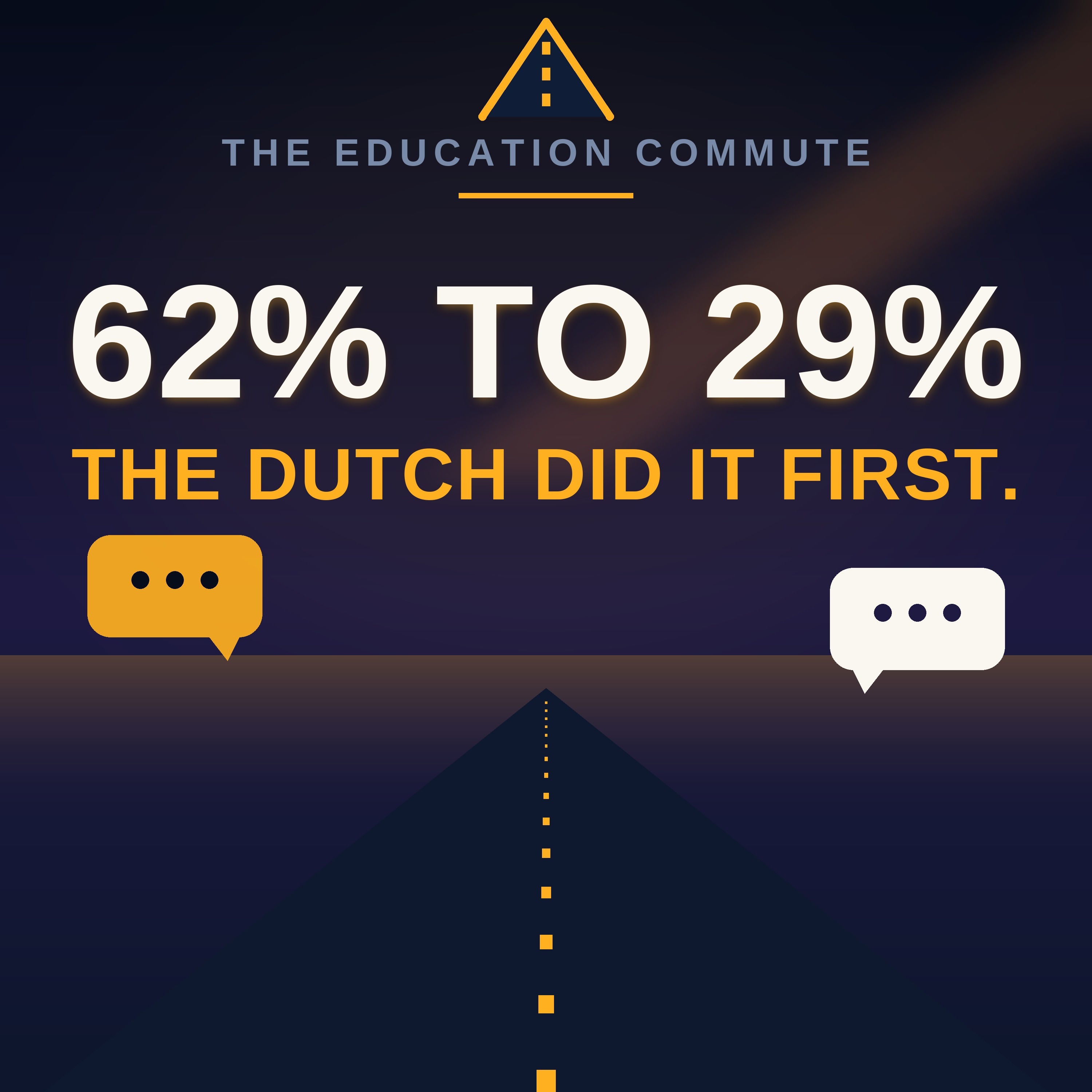
England's mobile-phone guidance became statutory this summer and applies from 1 September — the whole day, lessons to lunch. The Netherlands got there two years earlier with a softer rule, then had its ministry measure what happened. Sixty-two per cent of secondary schools called phones a problem before; twenty-nine per cent after. Concentration up, results barely — and some teachers reporting more physical bullying at break. What transfers, what doesn't, and the gap England has to plan for.
Sources: Ministerie van OCW (Netherlands) — Monitoringsonderzoek Landelijke afspraak mobiele telefoons en andere devices, factsheet (Kohnstamm Instituut & Oberon, 3 July 2025) — https://www.rijksoverheid.nl/documenten/rapporten/2025/07/03/bijlage-2-factsheet-eindrapport-monitoring-landelijke-afspraak-mobiele-telefoons-en-andere-devices-in-de-klas-kohnstamm-instituut-oberon ; Eurydice, 26 June 2025 — https://eurydice.eacea.ec.europa.eu/news/netherlands-ban-mobile-phones-classroom ; DfE — Mobile phones in schools (statutory from 29 June 2026) — https://www.gov.uk/government/publications/mobile-phones-in-schools/mobile-phones-in-schools
Printable one-pagers for this episode, for parents and for the staffroom, at theeducationcommute.co.uk.
Both voices on this show are synthesised; the research, reading and editorial judgement are done by a serving practitioner.
Strand: Global Pioneers
Free printable one-pagers for this episode, one for staff and one for parents and carers.
Get the free newsletters · Listen on RSS.com · Watch on YouTube
Full transcript
Read the transcript
This is the education commute. Both voices on this show are synthesized. The judgment isn't. 62 % and then 29%. We're talking about the exact same measurement here? Yeah. Like measured before an intervention and then immediately after? Exactly the same thing. Yeah. I want you listening right now in your car to just let those two numbers sit with you for a second. Right. 62%. Down to 29 percent. That is the share of Dutch secondary schools that called phone use in lessons a problem. Wow. Yeah. So 62 percent of them said it was a problem before the country's national phone agreement.
And just 29 percent said it was a problem after it. That is a massive drop. It's an immediate massive drop. And, you know, that data is pulled directly from their own Ministry of Education, Culture and Sciences monitoring report, the one that was just published in July 2025. And I think the reason we're looking at this specific report today, why we're looking at those exact numbers on this exact morning, is because England has just gone even further than the Dutch did. As of the 1st of September, yeah, they really have.
So welcome to the global commute strand of the education commute. I'm in the chair that has been, you know, reading the Dutch documents, pulling this data directly from the Ministry of Education, Culture and Science's own site. And I am sitting in the deputy head's chair today because I, well, like so many of you listening to this right now, I have just spent the entirety of August rewriting our school's phone policy to meet the new statutory guidance. Which is no small task. It really isn't. And what I really want to know.
What you likely want to know before you walk through the school gates this morning is what a country that is essentially two years ahead of us actually found when they did this. Right. How does the reality on the ground match the policy on paper? Exactly. Well, to understand that, we have to start with exactly what the Netherlands did, because when you look closely at the documents, it is definitely not what most people assume it is. What do you mean? First of all, it's not a law.
Oh, really? No. It is a landelik of spark. Which translates directly to a national agreement. It's an agreement between the Ministry of Education, Culture, and Science, and the bodies representing schools, the bodies representing teachers, the bodies representing parents, and the bodies representing peoples. This is not legislation. Not legislation. It is essentially one core sentence that everyone signed up to. I'll actually read it to you exactly as it's written in the document. Let's hear it. Let's pause on that exact phrasing for a moment. Because, you know, as a school leader, the boundaries are literally everything.
Yeah, they are. The agreement says... In the classroom. It does not say on the school site. In the classroom. Yeah. That is a critical boundary. That's the floor. And the way this national agreement works in practice is that each individual school writes its own rules on top of that baseline. OK, that makes sense. And the timeline for this rollout was phased. So secondary school started this from the 1st of January 2024. Then primary and special schools followed from the start of the 2024 to 25 school year.
Right. And if you go on the Ministry of Education, Culture and Sciences own page right now, I mean, I checked this just this month. It is still listed purely as an agreement. It has not been upgraded to a law. So if I'm looking at this from the deputy head's chair, how does that Dutch baseline actually compare to the document that just landed on my desk here in England? Well, the contrast is stark. I mean, it's huge. The Department for Education's mobile phones and schools guidance became statutory here on the 29th of June.
Right. And schools are expected to follow it from the 1st of September. Let me read you its own words so we can really hear the difference. Go for it. The English guidance says, quote, All schools should be mobile phone free environments by default. Anything other than this should be by exception only. That is a very different tone. Very different. And here is the real shift, you know, the part that changes everything for the people working in the buildings. It is for the whole day. Right. The guidance explicitly states, including during lessons, the time between lessons, break times and lunchtime.
Break times and lunchtime. I mean, if you are listening on your commute right now and you ever do a duty, you know. That is the big difference. Oh, absolutely. That is the whole game, isn't it? The Dutch agreement set the boundary at lessons. We have set the boundary for the entire day. Exactly. The Dutch agreement set lessons as the national floor. Now, I should say the Ministry of Education, Culture and Sciences report does explicitly note that most secondary schools went further on their own voluntarily. OK, so they pushed it.
Yeah. They instituted rules like keeping the device at home or in the locker or having fun. phones handed in at the very start of the lesson. But the point is the national mandate, the actual thing they all agreed to was just the classroom. Right. So we've established the rules. We know what was asked of them. Now for the autopsy. When you dig into this July 2025 monitoring report, what did the Ministry of Education, Culture and Science actually measure? Perceptions, mostly. And that is the very first entirely honest thing we have to say about this data.
Perceptions, okay. Yeah. Two research institutes commissioned by the Ministry of Education, Culture and Science measured perceptions. They didn't. you know sit in classrooms with stopwatches right they surveyed school leaders they ran group interviews with teachers with support staff with pupils and with parents and they did this comprehensively across secondary education primary education and specialist education so just to be absolutely clear for every teacher and leader listening to this right now they did not measure test scores no they're not telling us that grades went up not test scores no yeah so as we go through these numbers i want you to keep this caveat firmly in mind When I say effect on learning, what I actually mean is the share of school leaders who say they see an effect on learning.
OK, with that vital caveat established, let's look at secondary schools first, because that's where that massive headline grabbing drop happened. Right. The 62 percent of schools calling it a problem dropping down to 29 percent. Right. Let's unpack that. So here is what they found in those secondary settings. Ninety nine percent of secondary schools now have a phone policy. Almost everyone. almost everyone pupils simply bring phones to school less often than they did before now for the perceived effects schools reporting a positive effect on concentration 75 75 that's huge schools reporting a positive effect on the social climate 59 okay but Schools reporting a positive effect on learning results, just 28%.
In fact, the report's own phrase when summarizing the learning results is that they improved to a lesser extent. I want to really unpack those numbers because they are fascinating. They are. 75 % report a positive effect on concentration, but only 28 % report a positive effect on learning results. If you are a teacher listening to this on your commute, that gap... is the entire story of behavior management isn't it it really is everyone can look around the classroom and see that the room is undeniably calmer the obvious distraction is gone but barely a quarter of those school leaders will actually go on record to say the learning itself moved yeah we often conflate a quiet room with a learning room and this data shows exactly where that assumption breaks down and the people who would know that reality best i mean The clashing teachers who were in those group interviews, they named the very real costs of this policy, too.
They didn't just talk about the benefits. Not at all. They cited a significantly higher workload from having to enforce the rule. They talked about having to completely change how the school communicates with pupils now that they can't rely on digital nudges during the day. Right. That makes sense. And then there is this finding. Honestly, this is the one I genuinely did not expect to read in the official documents. What is it? They reported an increase in physical bullying and disruptive behavior. Wait. Stop. Say that again.
An increase in physical bullying and disruptive behavior. You're telling me that by removing the biggest distraction in modern schooling, physical bullying actually went up. Some of the teachers interviewed explicitly reported an increase in physical bullying and disruptive behavior after the phones went away. It is not hidden. It is explicitly listed as a negative effect right there in the Ministry of Education, Culture and Science's own fact sheet. Wow. We have all been operating on this collective assumption that the phones were purely a distraction, you know, an instigator of trouble.
Right. But this finding strongly suggests that for some kids, the phones were actually acting as a lid. If you take away the device that was absorbing all of their idle attention, that energy doesn't just disappear. Exactly. It has to go somewhere. I think you're absolutely right to focus on the how there because it makes logical sense of the data. And, you know, to be perfectly accurate to the source material, the report only records the observation, not the mechanism. Right. It doesn't say why. It simply states the fact that teachers saw physical bullying and disruptive behavior increase.
But the implications of that observation are huge. Absolutely. What the report also records is the sheer effort it took to get to this new normal. Forty -nine percent of secondary schools said enforcement took little or no effort. Which means? Which means, by definition, 51 percent, more than half of these schools, said it did take effort. Here is my push on this then. As someone looking at the English guidance right now. Go ahead. You have just given me a country where the rule was softer than ours.
It was a national agreement, not a law. It was for lessons only, not the whole day. Right. And even with that softer approach, over half the secondary schools still found it hard to enforce. And on top of that, some staff actually saw physical bullying and disruption go up because that digital lid was removed. Meanwhile, the Department for Education has just made the whole day statutory for us in England. What in this Dutch evidence tells me that England's stricter version will land any better? Nothing directly. That is the honest answer.
There is no Dutch number for what England has just done because they didn't test a whole day rule nationally. But what the report does give you, which is incredibly useful for us right now, is the three specific things that Dutch schools named as making a policy workable when they pushed it further. What were they? Number one. Clear communication. Number two, collective enforcement, meaning every single adult in the building enforces it every single time. Crucial. And number three, which directly addresses your point about the lid coming off, alternatives for phone use at break.
Alternatives at break. So the schools that voluntarily chose to ban phones at lunch had to actually be proactive and put something in that behavioral gap. Exactly. You can't just create a vacuum. No. In the examples recorded by the European Commission's Euridice Network, they specifically mentioned providing things like board games and conversation cards. Right. Now, I know that might sound a bit twee to a seasoned educator. It does sound a bit twee. But the Euridice Network recorded it for a reason. Because it sounds twee right up until you are the person on duty.
Standing in a hall of 314 -year -olds with absolutely nothing in their hands and 30 minutes to kill. Yes. That is exactly what I was agonizing over when I read the Department for Education's guidance this August. If they do not have a screen to stare at, what are they doing with their hands? Right. If we don't provide the board games or the conversation cards, they will find their own, likely less constructive ways to interact. Very true. Now, I want to pivot slightly. What did the primary schools find in the Netherlands?
Ah, primary schools. Because I know primary heads listening to this are reading the exact same statutory guidance from the Department for Education, and they are wondering why they are even included in this whole day mandate. The Dutch primary answer is almost funny, honestly, because it highlights exactly that confusion. 89 % of their primary schools have a policy. High number. But... Hardly any primary pupils brought a phone to school before the agreement anyway. So when asked, most primary schools saw no effect on concentration and no effect on learning.
There's a great quote from one teacher in the fact sheet that just bluntly says, we just don't have a problem with it. Because the phones weren't there. Exactly. And because they didn't have a problem with it to begin with. 81 % of primary schools said enforcement took little or no effort. That makes perfect sense. But there was one specific thing primary schools did flag. Smart watches. Ah. They noted that smart watches are harder to spot, they are increasingly being brought into the classrooms, and they are far less often enforced by staff.
Smart watches. Yes, any primary teacher listening will nod at that. Oh, yeah. That is very much a year five problem in England, too. It's the device that flies right under the radar because it looks like a standard piece of uniform until it lights up with a message. Exactly. And what about the specialist settings? How did they manage this national agreement? In specialist education, an overwhelming 93 % are enforcing a policy. And as you might expect, most of them make medical or support exceptions. Sure. The examples the report gives are things like hearing aids that are linked to a phone or text -to -speech software.
But interestingly, the report also explicitly notes that exceptions do not often seem necessary. Okay. The effect of the policy in specialist settings actually splits quite clearly by age. How so? In the older specialist settings, 53 percent of schools saw a positive effect on concentration and 60 percent saw a positive effect on well -being and the school climate. That's quite strong. It is. But in the settings with younger pupils, most schools either saw no effect whatsoever or they just couldn't judge one accurately. And how does that Dutch experience with exceptions compare to England's new statutory guidance?
Because, you know, speaking as a deputy head, that is the part that truly. keep school leaders up at night, getting the exceptions right legally and practically. England's guidance on exceptions is very explicit. It points directly to two specific legal duties. First, the Equality Act duty to make reasonable adjustments. And second, the Children and Families Act duty regarding medical conditions. The Department for Education guidance actually provides its own specific example to clarify this. It mentions a pupil with diabetes whose continuous glucose monitor links directly to their phone.
A very common, very real scenario. Exactly. But here's the crucial part. there's a line in the guidance that is really worth having ready in your mind if you have to manage these policies and communicate them to parents what's the line it says that flexibility for a pupil does not mean that these pupils should be exempt from all restrictions Interesting. The guidance dictates that the exception must have a specific purpose, a specific time, and a specific place. The exact example it gives for a specific place is a head of year's office.
So if we pull back and look at the whole picture we've painted today, it is the exact same overarching idea across all settings, but it plays out completely differently depending on which of the three rooms you are standing in. Exactly. Let's break down the reality of those three rooms. Room one, if you were in a primary setting, the Dutch evidence says... the phone rule mostly isn't the issue. The watch is the issue. So the highly practical question for you, if you are working in a primary school, is whether your behavior policy actually names smartwatches at all.
If it doesn't, that's your blind spot. Room two. If you are in a secondary school, the entire issue is the break time gap. If the statutory guidance says no phones at lunch, and the Dutch schools that manage that whole day rule successfully had to proactively put board games and conversation cards in pupils' hands instead, then we have to realize something fundamental. Which is? What is on the tables in the hall is no longer just a catering question for the site staff. It is now a primary behavior question for the leadership team.
Spot on. And room three, if you are in a specialist setting or managing SCN in a mainstream school, the focus is entirely on the exceptions list. Yes. It needs to be written down. It needs to be per pupil. And it needs to be strictly tied to the medical or support need under the Children and Families Act or the Equality Act. Because if you don't document it properly. Exactly. Because if you don't document it properly with specific times and specific places like the head of your office, he's allowed his phone stops being a reasonable adjustment and just becomes a destructive rumor among the other pupils.
Which brings us to the ultimate transfer verdict. Yeah. After digging through all this Ministry of Education, Culture and Science data, does this Dutch experience actually transfer to what we are facing in England this September? Partly and honestly. I mean, the Dutch result definitively says that a national rule shifts the perception of the problem and it shifts it remarkably fast. We saw that 62 percent dropped to 29 percent in just a year and a half. Why? But it does not say results instantly improve. Remember, only 28 percent of schools claimed a positive effect on learning.
And it makes it very clear that the true cost of this policy lands squarely on the shoulders of the staff. It absolutely does. It lands as increased workload. It lands as daily enforcement effort. And for some teachers, it lands as having to manage worse physical bullying and disruption at break time. You know, the core irony here is that everything England has now made statutory, the whole day ban, the break times, the lunch times is the exact part the Dutch left up to individual schools to decide.
Yeah. So the one thing their evidence cannot tell us is the one thing we have just decided to mandate from the top down. If you are pulling into the car park right now getting ready for the day, there is a very specific question you should ask whoever is standing next to the kettle at break today. Look around the room and ask them, what is actually in pupils hands at lunch now that the phones aren't? That's a great question. And more importantly, did anyone actually plan that or did it just happen by accident?
And if a governor came in today and asked to see your published phone policy, because the guidance explicitly says schools should publish details, and then that same governor asked to see the written adjustment for one named pupil, with a medical exception like diabetes, could you confidently produce both documents? A tough test. If that second one, the medical exception, is only a verbal agreement between staff, you need to write it down this week. So let's crystallize all of this before you turn off the engine and walk through the gates.
Yeah. Here are four things off the drive to take into school with you today. One, the Netherlands rule is a national agreement covering lessons. It is not a law covering the day. Right. And England's guidance is statutory. And it covers the whole day from the 1st of September. Two. The Dutch effect is real, but it is entirely based on perception, not test scores. 75 % of secondary schools saw better concentration, but only 28 % saw better learning results. 3. The costs are clearly documented in the exact same monitoring report.
The enforcement workload is real, and some teachers saw an increase in physical bullying and disruption at break as the behavioral lid was lifted. Yeah, you absolutely have to plan for the gap. 4. The exceptions are legal duties. They're not favors. Reasonable adjustments under the Equality Act and medical needs under the Children and Families Act are in England's guidance by name. And the duct specialist schools tell us they are rarely needed, but they must always be documented with a specific purpose, time and place. Everything we have discussed today, all the source documents from the Ministry of Education, Culture and Science and the Department for Education are linked in the show notes.
And there is a printable one pager for this specific topic available at TheEducationCommute .co .uk. You can bring it out for parents or you can just leave it on the table in the staff room to start a conversation. Excellent. Read the trailer, not the film. Both voices on this show are synthesized. The judgment isn't. Safe trip in. See you at the gates.
More episodes
Newer: 91% Sounds Like An A Grade: The Letter Still Says 'Persistent'
Older: A Nagging Doubt Is Enough: KCSiE's 23 Paragraphs On Staff Concerns
All episodes